
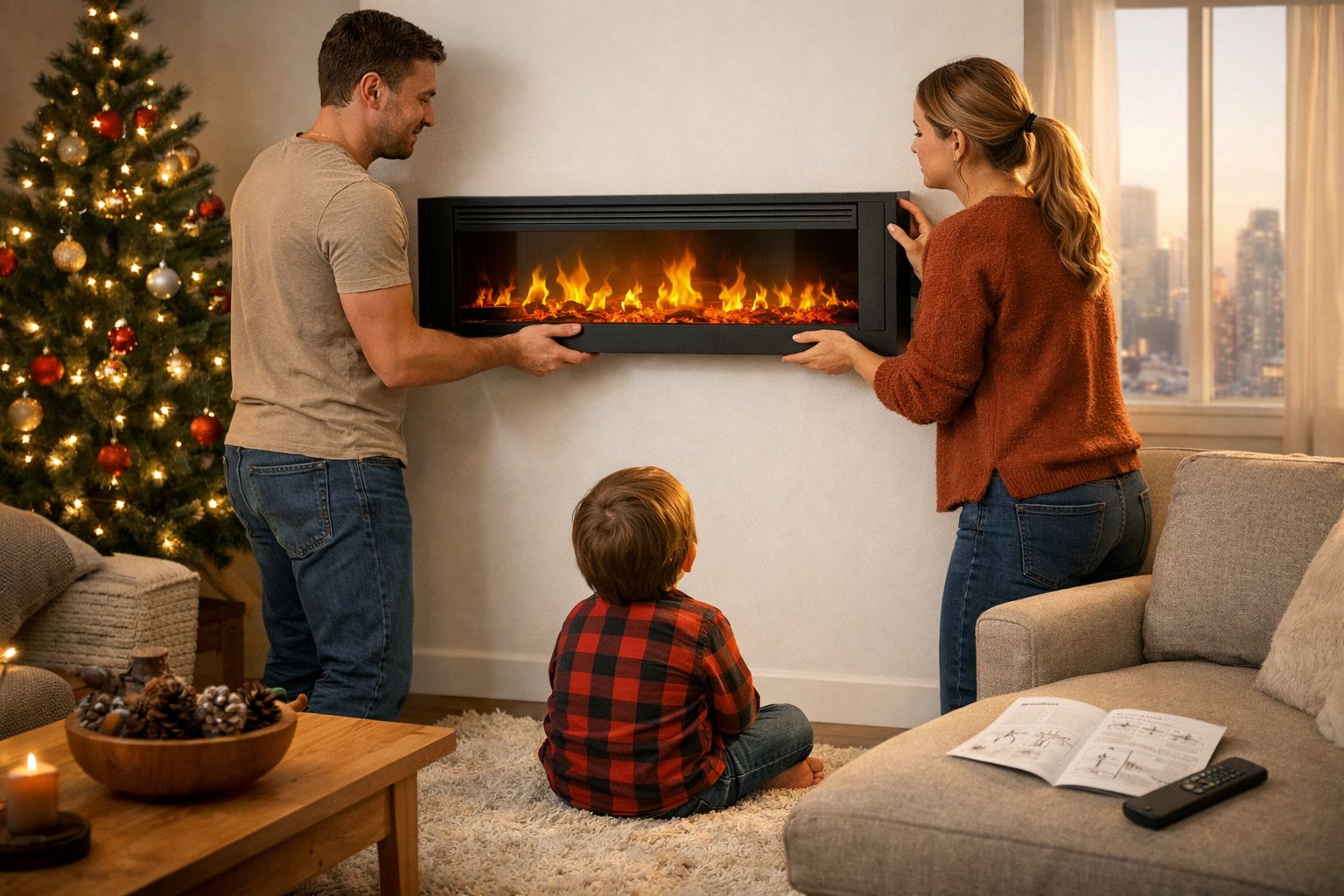
Em toda a Europa e no Reino Unido, a lareira a lenha clássica já não é vista apenas com saudade: para muita gente, junta-lhe agora preocupações com fumo, segurança e custos. Neste inverno, a nova vaga de lareiras elétricas promete a mesma sensação visual de aconchego, mas com muito menos complicações e uma instalação muito mais rápida.
Para quem quer o ambiente de uma lareira sem obras nem chaminé, esta alternativa está a ganhar terreno depressa. Em vez de depender de tiragem, condutas ou trabalhos em casa, basta ligar à corrente e, em poucos minutos, o espaço muda de cara - algo especialmente apelativo para apartamentos e casas onde instalar uma lareira tradicional simplesmente não é viável.
A new Christmas staple for homes without a chimney
For many city-dwellers, the fantasy of carols by a crackling fire never matched the reality of a small flat with no chimney, tight building rules and neighbours who hate smoke. Electric fireplaces now fill that gap. They bring the look of flames, the warmth of a heater and the feel of a focal point in the living room, without needing a flue or structural work.
One of the models driving the shift is the Kesser Prio, a freestanding electric fireplace that has been attracting attention after sharp discounts in early holiday sales on major platforms like Amazon. It targets people who want something that looks traditional but behaves like a modern appliance.
The new generation of electric fireplaces aims to replace gas and wood units with safer, plug‑in systems that can be installed in minutes.
The Prio offers a heating power of up to 1,900 W, enough to warm small to medium rooms to around 28°C in normal conditions. It uses LED technology to simulate realistic flames, visible through a three-sided screen, so the visual effect is not just frontal but wraps slightly around the sides, closer to a classic cast-iron stove feel.
Why flats are turning away from gas heaters
Gas heaters have long been the go-to option in many rental flats, but their image has eroded. Concerns about gas leaks, explosion risks, carbon monoxide and strict ventilation rules discourage more cautious tenants and landlords.
Electric fireplaces sidestep most of these problems. They connect to a standard socket, do not burn fuel and do not release combustion gases inside the room. They also avoid soot marks on walls and ceilings, which often cause disputes between landlords and tenants.
Key features that convince sceptical buyers
Beyond the cosy image, new devices compete on control and safety. The Kesser Prio, for example, integrates several functions that respond directly to the complaints people have about older heating systems:
- Dual power levels: up to 1,900 W for quick heating or a lower setting to maintain temperature.
- Thermostat control: the unit stops and starts automatically to keep a chosen temperature.
- Remote control: users can adjust temperature, timer and on/off from the sofa.
- Window-open detection: if the device senses a rapid temperature drop, it assumes a window is open and cuts or adjusts the heating to save energy.
- Decorative storage space: a compartment at the bottom to store fake logs or baskets, so the appliance looks integrated into the furniture rather than like a plain heater.
The compact size – around 64 x 35 x 49 cm – makes the Prio particularly attractive for small rooms. It can fit into a corner, under a TV or in place of an old, sealed fireplace, with no need to break walls or call a chimney sweep.
For renters, the biggest advantage is reversibility: the fireplace can be moved, unplugged and taken to the next flat with no trace left behind.
More modern designs for minimalist interiors
Not everyone wants a stove-style look with fake logs. For those who prefer cleaner lines, brands push contemporary versions that behave in the same way but shift the design language.
One example is the Kaminio “Hugo” electric fireplace, which also benefited from price cuts this season. It keeps the LED flame effect but adds ambient lighting and a more geometric front panel. Storage space at the bottom accommodates decorative wood, books or baskets, helping it blend into Scandinavian or modern living rooms.
Traditional vs modern look: what actually changes?
| Aspect | Traditional-style units (e.g. Kesser Prio) | Modern-style units (e.g. Kaminio Hugo) |
|---|---|---|
| Design | Stove-like, often with curved details and visible “log” area | Straight lines, large glass front, more “furniture” than “stove” |
| Flame effect | Warm tones, classic ember look, side viewing windows | 3D flame effects, coloured ambient LEDs, more theatrical options |
| Placement | Works well as a stand-alone feature piece | Often designed to sit under a TV or integrated into shelving |
| Target buyer | Fans of rustic, cottage or vintage interiors | Minimalist, contemporary and open-plan homes |
In practical terms, both categories tend to share the same core functions: thermostat, remote, LED flames, and built‑in heaters around 1,800–2,000 W. The real difference sits in how they change the room’s atmosphere and whether they visually dominate the space or quietly merge into the décor.
How these devices compare with other electric heaters
The Christmas discounts on fireplace-style heaters come in parallel with promotions on more utilitarian devices: fan heaters, simple radiators and wall-mounted panels from brands like Kesser, Tresko or Homcom. These options often cost less and aim at pure performance rather than aesthetics.
Some models integrate Wi‑Fi and app control, so users can switch them on remotely, adjust temperature before arriving home or connect them to voice assistants. From a comfort point of view, many buyers still prefer a visible “fire” as a focal point when sitting on the sofa, even if they also own other, more discreet heaters in bedrooms or home offices.
The real competition is no longer just between gas and electricity, but between anonymous white heaters and devices that double as decorative furniture.
Who gains most from an electric fireplace?
Households in these situations tend to benefit the most:
- Small flats without chimneys: a plug‑in unit gives a centrepiece and actual heat where structural work is impossible.
- Families with children or pets: cooler surfaces and automatic shut‑off functions lower risks compared with open flames.
- Renters: no permits, no drilling for flues, no long-term commitments with landlords.
- Allergy sufferers: electric units avoid smoke particles, soot and ash, which can irritate sensitive lungs.
- Second homes: quick start-up makes them useful for holiday houses that stay empty for most of the year.
What to check before buying
Impulse purchases around Black Friday and pre-Christmas sales can disappoint later if a few basic points are ignored. Before adding a discounted fireplace to the basket, buyers should pay attention to:
- Room size: 1,800–2,000 W usually suits rooms of around 15–30 m². Larger spaces may need extra heating or multiple units.
- Electrical capacity: older buildings with overloaded circuits might struggle with high‑wattage devices used at the same time.
- Noise level: fan-assisted models can produce a low hum. For bedrooms, quieter units make more sense.
- Flame-only mode: some people want the fire effect without heat, especially during spring or autumn. Not all models offer this, so specs matter.
- Energy-saving functions: window-open detection and precise thermostats can reduce bills during long cold spells.
Energy prices remain volatile across Europe and the UK, so running costs stay part of the calculation. Electric fireplaces convert almost all input electricity into heat, but electricity often costs more per kilowatt-hour than gas. That means they work best as supplementary heaters rather than the only source of warmth in a poorly insulated home.
Beyond Christmas: using flame effects all year
Manufacturers now market these devices as more than seasonal accessories. Because LED flames consume much less energy than the heating function, many owners keep the fire effect on during cool spring evenings with the heat off. The living room still feels staged for relaxation, without turning the space into a sauna.
Some users even pair electric fireplaces with smart bulbs, dimmable ceiling lights and light strips to create scenes: movie mode, reading mode or dinner mode. The fireplace becomes part of a broader lighting strategy, not just a heater dragged out from storage in December.
The psychological effect of a flame, even a fake one, still shapes how people use their living rooms, long after the Christmas tree has gone.
Extra tips: combining comfort, safety and cost
To judge whether an electric fireplace fits a specific home, a simple rough simulation helps. Take your electricity tariff, multiply the price per kWh by the heater’s power and by the planned hours of use. For example, a 1,900 W unit running for three hours at an average price of 0.30 €/kWh would cost around 1.71 € for that evening. Shorter sessions focused on peak moments of the day can keep bills under control.
Positioning also plays a role. Placing the fireplace against an internal wall, away from draughty windows and doors, lets the room warm up quicker. Keeping at least a few tens of centimetres free around the vents prevents overheating and lets the fan distribute warm air more evenly.
Builders and architects already factor these devices into future renovations. Many new flats include a dedicated niche or reinforced wall section wired for a plug‑in fireplace, without any real chimney behind it. For households that still miss the smell of real wood, mixing a small outdoor fire pit or occasional log burner in a well‑ventilated space with an electric fireplace indoors can balance romance and practicality during the colder months.



Comentários
Ainda não há comentários. Seja o primeiro!
Deixar um comentário