
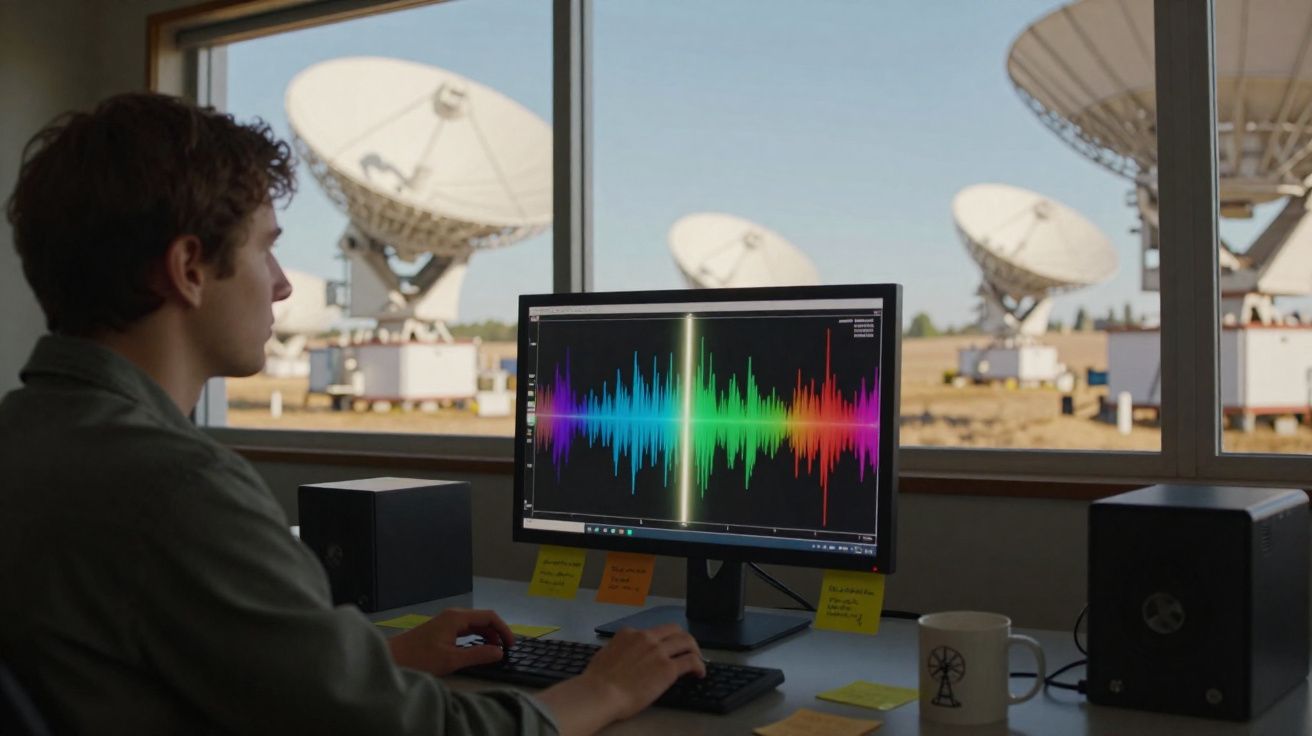
Radiowaves, laser flashes, heat traces from gigantic engineering: the hunt for signals from alien civilisations is running at full speed. Yet the screen remains blank. A new study by a physicist from the EPFL in Lausanne now raises an uncomfortable question: perhaps the signals already passed by - and we came away empty-handed because physics and statistics are mercilessly stacked against us.
O que os cientistas entendem por tecnossinaturas alienígenas
No jargão científico, possible traces of extraterrestrial civilisations are called “technosignatures”. This refers to all measurable signs of technology, such as:
- artificial radio waves from other star systems,
- extremely short, bright laser pulses,
- thermal radiation from mega-structures in space,
- unusual brightness patterns around stars that do not fit natural processes.
For us to detect such a signal, two conditions must be met:
- The wave must actually reach Earth.
- Our instruments must be sensitive enough and correctly tuned to filter it out of the noise.
The first point sounds straightforward, but it is deceptive. Space is enormous, signals spread only at a limited speed and grow weaker with distance. The second point is almost even more unforgiving: telescopes always measure only certain wavelengths, with limited precision and only during particular time windows. A brief pulse can arrive at a moment when nobody is looking.
Searching for aliens is like blinking during a light show that lasts 100,000 years - and for most of it, we were not in the hall.
O novo estudo: o que a estatística revela sobre sinais alienígenas
The theoretical physicist Claudio Grimaldi from the Escola Politécnica Federal de Lausanne has now tackled the problem with statistics. He wanted to know: how many signals would, in pure calculation, already have had to pass through Earth for us to have a realistic chance of catching one today?
To do that, he models, among other things:
- how long a civilisation transmits for (the lifetime of the technosignature),
- how far a wave spreads during that time,
- how many potential transmitters there could be in a region of the Milky Way,
- and how often their “signal bubbles” intersect with Earth.
His result is sobering: for us to have a good chance of detecting a signal today, an unimaginable number of signals would have had to sweep through our Solar System in the past - far more than seems plausible given the number of potentially habitable planets.
In other words: either countless civilisations are constantly broadcasting in all directions - or the statistical probability of us catching something right now, with our limited technology, is vanishingly small.
A ideia da “casca de sinal” no espaço
Grimaldi illustrates this with the image of a spherical shell of waves expanding from a transmitter. If a technological civilisation starts up somewhere in space and transmits for a certain period, a hollow sphere of radiation grows around it.
| Fase | O que acontece? |
|---|---|
| Mais cedo | A casca de sinal is still small, and Earth lies outside it. |
| Janela de impacto | The shell cuts across Earth’s orbit - only during this period can we receive the signal. |
| Mais tarde | The shell moves on, Earth is once again inside the “empty hole” and gets nothing more. |
The time window in which we could even receive these signals is limited. And we would have to be looking by chance during that exact phase, in the right frequency range, with the right sensitivity. One small shift - and the moment is gone.
Porque é que ficamos de mãos a abanar apesar de décadas de procura
The Milky Way is roughly 100,000 light-years across. Our radio telescopes and optical instruments cover only tiny slices of it - spatially, temporally and spectrally. Many observations last only seconds or minutes per patch of sky. In between, our detectors are silent, even if space itself may be noisy.
Researchers like to talk about “a needle in a haystack”, but the image is almost too generous. A more realistic comparison is trying to catch the blink of a distant lighthouse while driving past with your eyes closed - and only opening them for a split second now and then.
The properties of the signals themselves add to the difficulty:
- Beamed signals such as laser beams lose strength with distance and only cover a tiny cone of space. Earth must sit precisely on that line - otherwise the beam passes us by.
- Omnidirectional emission such as heat released by mega-structures spreads in all directions. That increases the chance of being hit at all, but it also weakens the signal dramatically. It can easily disappear into the natural noise of stars, gas clouds and galaxies.
Grimaldi therefore reaches an uncomfortable conclusion: the fact that we have not yet found anything definitive does not necessarily argue against alien technology - it may simply mean that our observation window is absurdly small.
The silence of space may be less a cosmic hush than our own technical whisper in the storm.
O que isto significa para a grande questão da vida extraterrestre
The study feeds into the debate around the famous Fermi paradox: if the universe is full of planets, why do we not see any aliens? Grimaldi’s calculations offer one possible part of the answer: perhaps they do transmit, just not continuously, not everywhere, and not strongly enough for our still-young detectors.
Another point is that technological civilisations may be short-lived. If they only transmit for a few thousand years, their signals are also detectable only within a limited space-time volume. If the signal shell reaches us while we are still using optical telescopes without radio receivers, the opportunity is lost.
Como o SETI reage a estas conclusões
Projects such as SETI are already adapting: they scan larger and larger portions of the sky, use broader frequency bands and analyse archive data with AI to uncover patterns that were previously missed. Even so, the basic limitation remains: observation time, computing power and telescope capacity are finite.
The new statistical perspective suggests that the search has to be thought about much more long term. Not years or decades, but time spans measured in centuries could be needed to collect meaningful data.
Como seria, na prática, um sinal perdido
A practical scenario: a distant civilisation transmits powerful radio waves for 500 years before stopping. Its signals reach our Solar System exactly in the 18th century. Back then, there is neither radio technology nor radio telescopes. The waves brush past Earth - nobody notices. In the 21st century we are looking into space with state-of-the-art equipment, but the signal shell has long since moved on. To us, it appears as if the civilisation had never existed.
Even today, we remain vulnerable to such gaps. Many radio telescopes record data only within certain frequency windows. An exotic signal outside those ranges leaves no trace in our archives, no matter how strong it is.
O que os leigos devem saber sobre frequências, ruído e sensibilidade
Anyone who wants to understand the issue better can think of a radio. If you slowly turn the dial across the band, you hear music, then static, then speech again. If your favourite station broadcasts only very briefly and happens to do so exactly while you are tuning past it, you miss it. Telescopes work in a similar way:
- They “turn” through different frequencies.
- They “sweep” across different directions in the sky.
- They only record for limited periods on each target.
Noise comes not only from space, but also from the equipment itself. Every detector has a sensitivity threshold. Anything below that disappears like a quiet whisper in a noisy bar. This makes one thing clear: the question is less whether aliens could theoretically send signals, and more whether our radio instruments are powerful enough to stay switched on, and long enough, to catch them.
For the future, this means: the larger, more sensitive and more diverse our instruments become, the more likely we are to capture such signal shells. Combined with clever statistical models like the one Grimaldi proposes, observation strategies can be planned more precisely - moving away from hoping for luck and towards systematically probing the Milky Way.






Comentários
Ainda não há comentários. Seja o primeiro!
Deixar um comentário